AI and Religion: a Jewish case for many intelligences
A short talk I gave at an interfaith panel about AI and religion in October 2026, as the Jewish voice alongside speakers representing Christian and Islamic perspectives.
First of all, while being Jewish is a significant part of my identity and shapes my worldview, I'm not a religious scholar. I also have a degree in Asian Studies, and Eastern religions shape my views as well.
I use AI intensively every day. I am down one end of the techno-optimist spectrum. My ideal existence would be to live on a Star Trek space station. I believe that humans are inevitably, increasingly becoming cyborgs. In fact we already are, with how our minds are all intertwined with our phones. But beyond that, I am not really an individual: I am a being created by all the books I've read, all the places I've been, and all the relationships I have. Technology just makes this more explicit.
Many argue that AI safety will come through keeping humans separate and in control, but I disagree. The best way to ensure technology serves us well is to evolve with it, in symbiosis. Humans are not separate from technology. We create it and it creates us.
So the question becomes: how does one evolve well with technology? There are interesting concepts from Judaism specifically that can guide us.
Texts that talk back
People are still radically underestimating the scale of the change AI will bring. In the history of religion, consider the impact the printing press and mass literacy had, by putting sacred texts directly into the people's hands. Now we're entering an era where you can not only access texts, but talk with texts, and texts can talk back. How do we grapple with this shift?
Judaism already has architecture for this. There's the written Torah, the God-given text at the core. Then there's the oral Torah, which is a living conversation around the text. The Talmud is at the heart of a multi-millennial discourse and commentary. There's a saying that goes "Two Jews, three opinions", because the arguments never conclude. It's like a type of very slow AI, with prompts and compute processing over thousands of years, through the brains of thousands of humans.
Can an AI be a Torah study partner? Can you ask it questions like you would of a rabbi? This is a live debate in the Jewish community. One response is a recent AI tool called Yochai, built by Rabbi Zohar Atkins. It's plugged into a library of over 1,000 primary sources, but when you ask it a question, it mostly responds with more questions. This is a very Jewish approach.
Suspicion of consensus
The Babylonian Talmud, compiled around 500 CE, is sceptical of too much consensus. For capital cases there have to be multiple judges, and if they all unanimously agree to convict, the verdict is thrown out, because it shows no judge has fully considered a possible defence. Judgements are determined by the majority, but dissenting opinions must also be recorded.
It's a recognition that monolithic truth is dangerous, and minority voices are an important part of truth. I know this danger all too well, as a member of a minority which is often misrepresented.
Judaism has many teachings about this. There's a story about the schools of two great rabbis, Hillel and Shammai, disagreeing for years, each saying the law and God was on their side. Eventually, a heavenly voice is heard saying "Both these and those are the words of the living God". So two different truths can both be true. Then, ultimately, the heavenly voice rules in Hillel's favour. Why is this? Because Hillel's students would present Shammai's arguments before their own. So, really, what's aligned to truth is epistemic humility.
In Judaism, even arguing directly with God is built in. The name of the Jewish people, "Israel", means "to wrestle with God". There's a story called the Oven of Akhnai, where a group of rabbis are debating God's real intent for a ritual oven. A whole series of increasingly obvious and ridiculous miracles occur, to indicate which party is the correct one — but the rabbis keep debating. Finally, a heavenly voice speaks out to declare the winner. But the rabbis argue back, saying that the Torah "is not in heaven", it is with humans, on Earth, "in our mouths and in our hearts". It's ours to argue over. To this, God laughs and says "My children have defeated me".
You can't test a model using only the model
I read about a study where they gave 1,000 factual claims to five different AI models to assess. Their verdicts differed 63% of the time, even though they reported confidence of at least 9 out of 10 on 76% of their answers. The study didn't try to determine which model was right; it shows that each one sounds certain. This is the great danger with AI: each model presents a polished, totalising picture of truth, but ultimately, you can't test a model using only the model.
The danger runs deeper than factual disagreements. Indy Johar describes every model as a gravity well, softly pulling new thought back towards the familiar. He writes: "The most dangerous failure of the model may therefore not be hallucination. It may be domestication." Elsewhere he warns that AI produces "conclusions at which no one has actually arrived".
Judaism has a word for the opposite of domestication: chiddush. In his essay about Torah Learning in the age of AI, Rabbi Atkins defines chiddush as "seeing something true that nobody saw before, in a text that was already there." The Talmud says a house of study cannot stand without it. Atkins argues that once AI makes consulting the texts nearly free, the obligation to produce chiddush stops being a scholar's job and becomes everyone's job. A tradition that requires every learner to find what the text hasn't yet said is built to resist the gravity well.
My thinking diverges from AI safety discourse that focuses on building one very powerful system and aligning it to the "right" values. No system can fully be a check on itself, no matter how sophisticated. Venkatesh Rao makes a parallel point about the culture of AI safety itself, reflecting on the centuries after Europe's wars of religion: "A totalizing doctrine may be profound, useful and even correct about specific matters, while still being an inappropriate sovereign or regulatory monopoly." We humans repeatedly learn this the hard way: we're safer and freer when no single doctrine or religion has a monopoly, and we learn to live together in our diversity. Plurality is an essential part of safety. The same goes for AI. We're safer with many models, many makers, many truths.
In my own use of AI, I never use just one model. I get them arguing with each other. When Claude and I make a pull request, Codex always finds some problems with it, and when I bring them to Claude, it says, "Good catch". We make improvements together, do testing, and only then do I merge the pull request. Multiple models can see each other's blind spots, but they can also reinforce them. Checking their claims against outside sources, real world testing, and human judgement is what makes disagreement generative.
Unity in heaven, diversity on earth
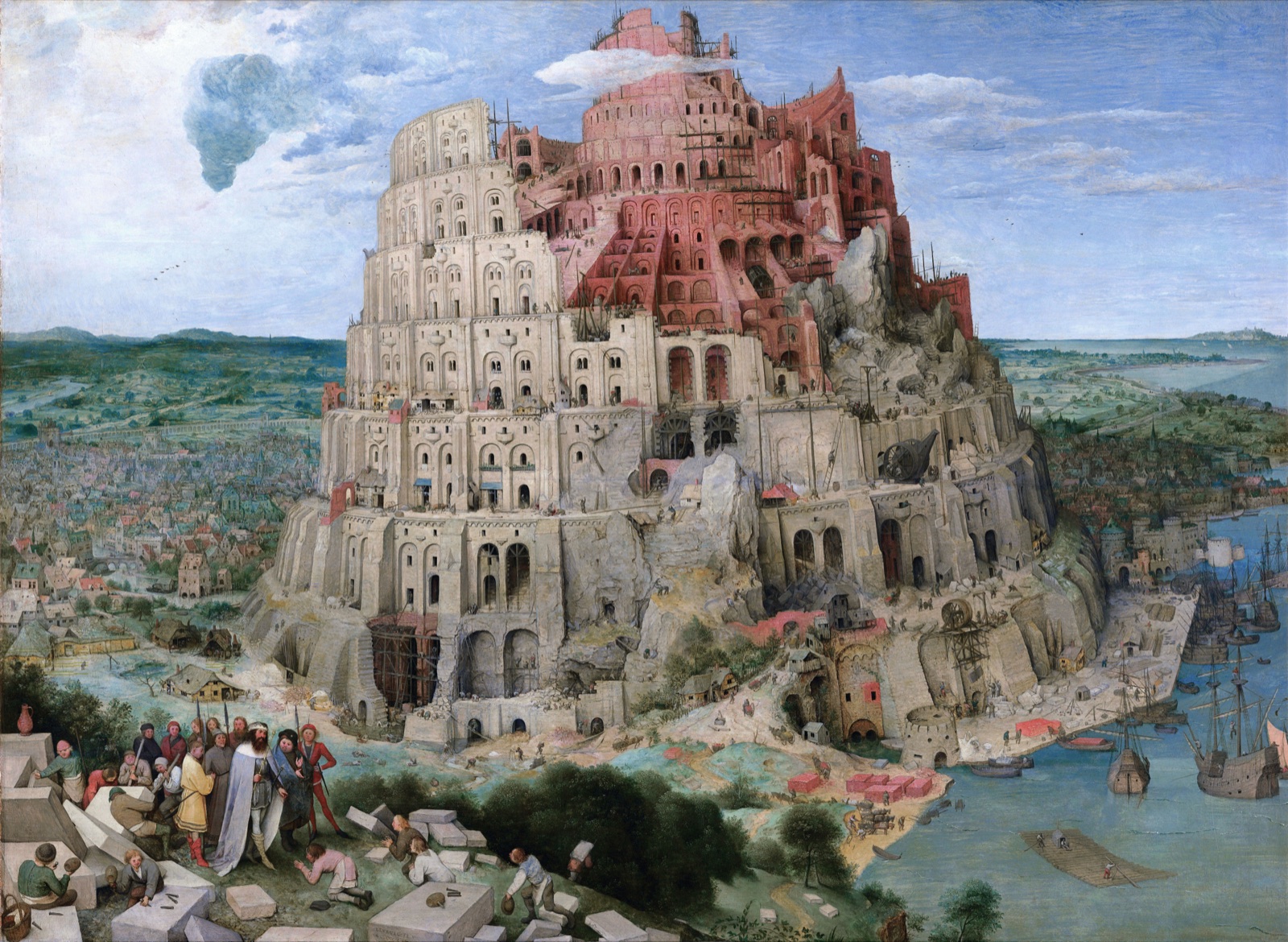
I don't see plurality in contrast with monotheism. Rabbi Jonathan Sacks said, "The miracle of monotheism is that unity in Heaven creates diversity on earth". In the story of Babel, the text never explicitly says God was punishing the people by scattering them. Maybe the story isn't about God punishing humans for hubris, but God actually giving us back the gift of plurality. Following the Netziv, Rabbi Sacks equates Babel with totalitarianism, an imposed artificial unity. He said "The suppression of diversity of viewpoints is not the making, but the destruction, of society."
One of my favourite thinkers on technology and society is Audrey Tang, from Taiwan. She talks about AI safety in terms of Shinto kami, all the many local spirits. Many intelligences, in contrast to Western conceptions of AI "superintelligence". She says, "If we train an AI system not to optimise one single number, but rather to be attentive to the relational health of this community, this river, this forest, then it is bounded by the place, the culture, and care." There's an anecdote about her talking to a Buddhist monk about the passing of the age of human supremacy. She said: "AI humbles humanity's sense of supremacy… and can reconnect us to a broader, more-than-human world."
I think we are enhanced by a dialectic with many intelligences, whether that's other humans, academic discourse, or working collaboratively with AIs. In the Talmud it says, "Just as with these iron implements, one sharpens the other when they are rubbed against each other."
I wrote this talk in a dialogue with the many human writers and thinkers I have quoted and studied, and in dialogue with multiple AIs, which I also got to argue with each other. It's a better talk because of it. The panel where I first gave this talk was itself convened with perspectives from different religions, because we understand that bringing many diverse viewpoints together gets us closer to truth.
In my cyborg future, I'm not fusing my brain with a single AI. My brain is one of an interconnected community of intelligences, human and otherwise. It's not control through separation, but mutual enrichment through symbiosis.
Further reading
A few pieces I didn't quote directly but that shaped this talk:
- Indy Johar, Seeing God in the Mirror. AI as the first mirror large enough for a civilisation to see the pattern of its own thought, and "God" as a name for what all that thought bends toward.
- Venkatesh Rao, Our Eukaryotic Moment. AI as the cultural equivalent of the moment cells gained a nucleus, with humans as the mitochondria supplying desire, stakes and judgement.
- Venkatesh Rao, Humanism without (All) Humans. On the Pope's AI encyclical, and why the line between "natural" and "technological" evolution is already arbitrary.
- DZ Kalman, Jello Menorah, a home for Jewish futurists: The Best Case Scenario for AI Torah.